• French (Fr)
  • English (United Kingdom)
our destinations Namibia country presentation

Namibia  carte_namibdrapeau_namib

Namibia, officially the Republic of Namibia (Afrikaans Republiek van Namibië, German: Republik Namibia), is a country in southern Africa whose western border is the Atlantic Ocean. It shares land borders with Angola and Zambia to the north, Botswana and Zimbabwe to the east, and South Africa to the south and east. It gained independence from South Africa on 21 March 1990 following the Namibian War of Independence. Its capital and largest city is Windhoek (German: Windhuk). At 825.418 km2 (318.696 sq mi), Namibia is the world's thirty-fourth largest country (after Venezuela). After Mongolia, Namibia is the least densely populated country in the world (2.5 inhabitants per square kilometre (6.5 /sq mi)).

The Namibian landscape consists generally of five geographical areas, each with characteristic abiotic conditions and vegetation with some variation within and overlap between them: the Central Plateau, the Namib Desert, the Great Escarpment, the Bushveld, and the Kalahari Desert. Although the climate is generally extremely dry, there are a few exceptions. The cold, north-flowing Benguela current of the Atlantic Ocean accounts for some of the low precipitation.

The official language is English. Until 1990, German and Afrikaans were also official languages. Long before Namibia's independence from South Africa, SWAPO had decided on the country's becoming officially monolingual, consciously choosing this approach in contrast to that of its neighbour which was regarded as "a deliberate policy of ethnolinguistic fragmentation." Therefore, English became the sole official language of Namibia. Afrikaans, German, and Oshiwambo became recognised regional languages.

The Christian community makes up at least 80% of the population of Namibia, with at least 50% of these Lutheran. At least 10% of the population hold Indigenous beliefs. Islam accounts for 3% of the population. The faith of the remaining portion of the population is unknown.

Namibia is the only country in the world to specifically address conservation and protection of natural resources in its constitution. Article 95 states, “The State shall actively promote and maintain the welfare of the people by adopting international policies aimed at the following: maintenance of ecosystems, essential ecological processes, and biological diversity of Namibia, and utilization of living natural resources on a sustainable basis for the benefit of all Namibians, both present and future.”

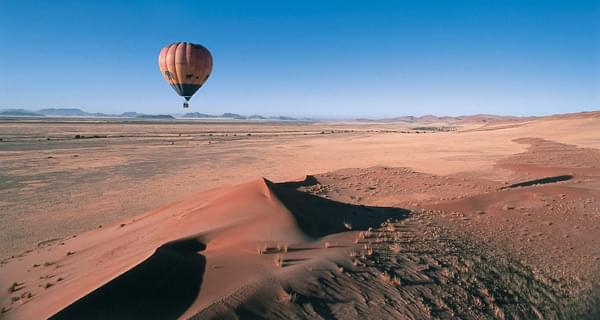
Namibia generally attracts eco-tourists with the majority visiting to experience the different climates and natural geographical landscapes such as the great eastern desert and plains. There are many lodges and reserves to accommodate eco-tourists. In addition, extreme sports such as sandboarding and 4x4ing have become popular, and many cities have companies that provide tours.

The most visited places include the Caprivi Strip, Fish River Canyon, Sossusvlei, the Skeleton Coast Park, Sesriem, Etosha Pan and the coastal towns of Swakopmund, Walvis Bay and Lüderitz.
 

Climate

Namibia's climate is typical of semi-desert terrain, hot days and cool nights. The coastal regions are cooled by the cold Benguela current, causing fog and inhibiting rainfall. Over the central plateau in the country which is higher up, temperatures are understandably lower.

With 300 days of sunshine on average per year, Namibia is truly a sunny place. Only during the summer months from November to February does rain occur, mostly as heavy thunderstorms. Then the usually dry riverbeds become saturated with torrents of muddy water in a very short time. It is during this time that the sun-scorched land comes to life and develops a colourful horizon to horizon floral carpet within a few days. The interior enjoys two rainy seasons: the short season is between October and December, marked by frequent thunderstorms. The longer season is from mid-January to April.

Summer is from October to April. Temperatures can reach 40º C which plummet at night to cool levels. Average daily temperatures range from 20 to 34º C.  Winter is from May to September with wonderful warm days which are contrasted by very cold nights, when temperatures often drop to below freezing.

Namibia enjoys an average of 300 sunny days a year and the main camps in Etosha National Park are open all year round. The best time for visiting the Namib desert is from May - September when temperatures are cooler - note however the nights can get cold. Swakopmund is a popular seaside resort especially over Christmas and Easter so advance bookings or avoiding those times should be considered. In the Fish River Canyon area some of the camps may close from November until mid-March mainly due to high temperatures.

Tourmaline safaris - Travel Safari in Namibia - Botswana - South Africa


South Africa
: Free State   Limpopo Nothern Cape Western Cape Eastern Cape Kwazulu Natal North-West Province Mpumalanga


Our trails lodge and camping in Namibiain  Botswana |   in South Africa

Sitemap
Our contact in Namibia : Phone/Fax : 00 264 61 22 01 97 - info@tourmalinesafaris.com
Address : P.O. Box 40 739, Windhoek - NAMIBIA